
Edgecombe Criminal Court Records
The Edgecombe County Criminal Division schedules and retains records for criminal case matters. Its local duties include open traffic violations, missed criminal court dates, felony case files, closed traffic and criminal misdemeanor files, criminal record checks, expunction process, criminal bail bonds and bond forfeitures, misdemeanor appeals, and other Criminal Superior Court matters. That makes the Criminal Division the key local office for criminal court records once a case exists in the court system.
North Carolina uses District Court and Superior Court as trial divisions. Misdemeanors and infractions are usually handled in District Court. Felonies often begin with magistrate process and early district-level appearances, then move to Superior Court after indictment or other transfer steps. The District Attorney for Prosecutorial District 8 prosecutes criminal cases filed in Edgecombe, Nash, and Wilson Counties. For a closer look at the charging stage itself, use court charge records; for all case types, use court records.
The source image for the local criminal office is the Edgecombe Clerk Criminal Division page, which lists criminal records, traffic tickets, missed court dates, felony files, expunctions, and bond matters.
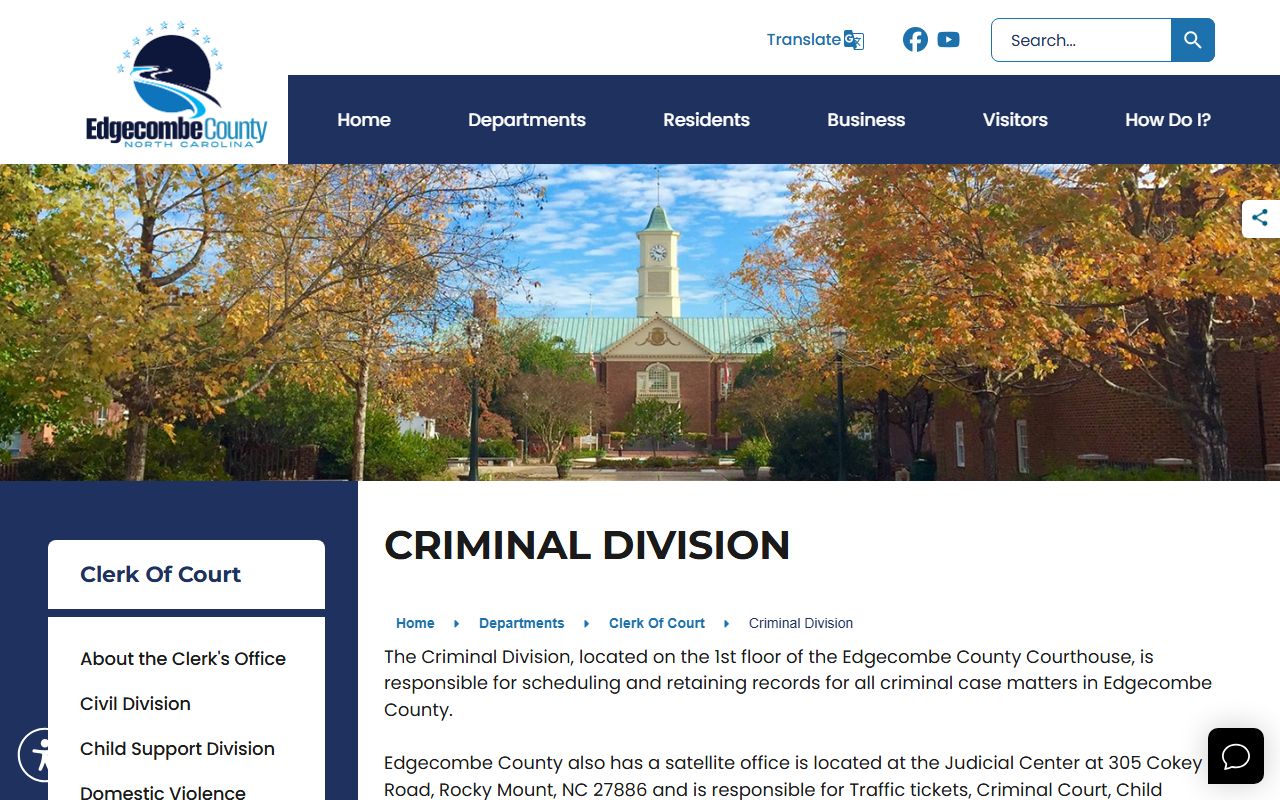
That local office description keeps the criminal court records focus on the case file, not a general arrest search or county jail lookup.
Search Edgecombe Criminal Cases
The online starting point is the NC eCourts Portal, where Smart Search can locate court records and case information. Search by defendant name, case number, or record number, then narrow by Edgecombe County, case type, status, and file date when needed. Search Hearings is better for a court date or hearing setting, while Smart Search is better for the criminal case record and docket history.
- Open the NC eCourts Portal and choose Smart Search for criminal case information.
- Enter the defendant name in last, first format, or enter the case number if it is known.
- Use Advanced Filtering Options to select Edgecombe County, then add case type, case status, or file dates only if needed.
- Open the matching case and review docket entries for hearings, bond events, charges, pleas, dispositions, and sentencing.
- Request a certified copy or official criminal record check from the Edgecombe Clerk when a screen view is not enough.
Edgecombe's criminal record check process is separate from casual Portal searching. The clerk's page says to use AOC-CR-314, provide the name to be checked, and submit the $25 statutory fee. In person, the request goes to Suite 102 on the first floor of the courthouse. By mail, the request goes to the Clerk of Superior Court, ATTN: Criminal Division - Records, PO Drawer 9, Tarboro, NC 27886, with a certified check or money order and a self-addressed stamped envelope.
The source image for record checks is the Edgecombe criminal record checks page, including the fee and name-search caveat.
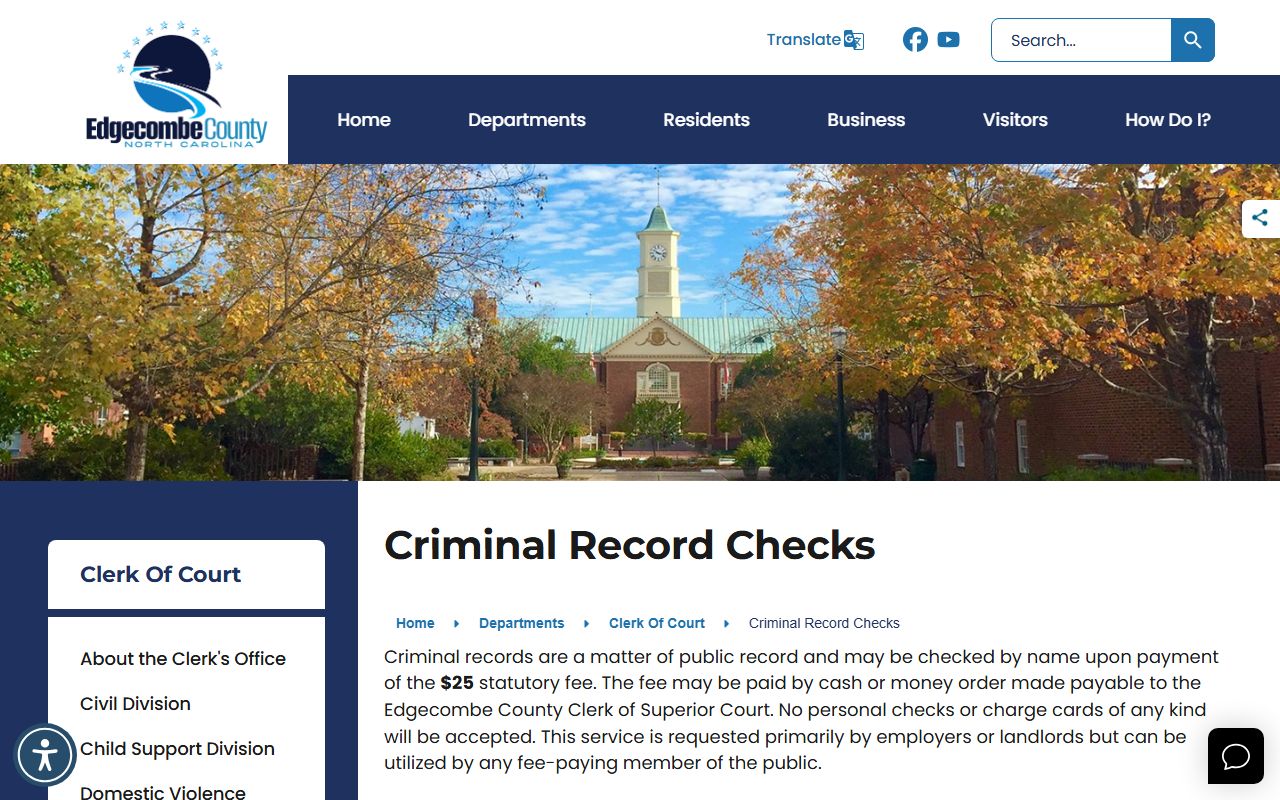
The clerk warns that the Edgecombe record check is name-based, covers only charges filed in Edgecombe County, and may return multiple people when names are common.
Criminal Case Flow
A criminal court record grows as the case moves through court. The charge or citation starts the case record, but the court file becomes more complete as hearings, motions, pleas, orders, and judgment entries are added. An in-custody defendant may also have jail and bond details, but custody status is separate from the court file. Use inmate records for jail status and warrant records for active warrant channels.
Case flow: Charges Filed › Arraignment › Pretrial and Motions › Plea or Trial › Disposition › Sentencing
| Stage | What Happens |
|---|---|
| Charges filed | A citation, warrant, complaint, information, or indictment identifies the alleged offense and starts the court case path. |
| Arraignment or first appearance | The court addresses the charge, appearance status, counsel issues, bond, and next hearing settings. |
| Pretrial and motions | Parties file motions, request continuances, address discovery, negotiate pleas, and prepare for hearing or trial. |
| Plea or trial | The defendant may plead guilty or not guilty, or the case may be tried before a judge or jury depending on court level. |
| Disposition | The record shows the outcome, such as guilty, not guilty, dismissed, reduced, or another court result. |
| Sentencing | If there is a conviction, the judgment can show fines, costs, probation, custody, restitution, or other sentence terms. |
What Criminal Records Show
An Edgecombe County criminal court record is a field-by-field account of a case, not just a summary of an arrest. It may include the court division, county, defendant, charge text, statute, case number, bond entry, hearing settings, docket entries, disposition, sentence, and payment data. Some records also link to documents, but public document access can vary by user role, case type, and confidentiality rule.
| Field | What It Shows |
|---|---|
| Case number | The file number used by Portal, the clerk, calendars, hearings, payments, and copy requests. |
| Defendant | The accused person's name and party role in the criminal case. |
| County and court division | Edgecombe County and whether the matter is in District Court, Superior Court, or another criminal track. |
| Charges | The alleged offense, statute reference, severity, charge status, and whether a charge was amended, reduced, dismissed, or tried. |
| Bond events | Release conditions, bond amount or type, forfeiture entries, or related court action when public. |
| Hearings and motions | Court dates, continuances, motions, orders, arraignment, pretrial events, and trial settings. |
| Plea and disposition | The plea, verdict, dismissal, not-guilty result, guilty finding, or other case outcome. |
| Sentence | Costs, fines, probation, custody, restitution, and other judgment terms after conviction. |
The source image for state criminal procedure context is Chapter 15A criminal procedure statutes.
Chapter 15A is broad, but it is the state-law framework behind many criminal case filings, outcomes, and expunction rules.
Charges vs Convictions
A charge is an accusation filed into the court system. A conviction is a court outcome after a guilty plea, guilty verdict, or other finding that supports judgment. A criminal court record can show charges that were dropped, dismissed, reduced, amended, or ended in a not-guilty verdict. That is why a case record should be read through the disposition and sentence, not stopped at the first charge line.
| Point | Charge | Conviction |
|---|---|---|
| Meaning | Alleged offense filed by citation, warrant, complaint, information, or indictment | Outcome based on a guilty plea, verdict, or qualifying finding |
| Where it appears | Early docket entries, charging documents, hearings, and case summaries | Disposition, judgment, sentencing, probation, costs, and final records |
| Can change | May be amended, reduced, dismissed, or replaced | May be appealed, corrected, modified, or expunged if legally eligible |
| How to read it | Check each charge count and current status | Confirm the final disposition and sentence terms |
Note: A background decision should not treat every charge entry as a conviction without reading the final disposition.
Dispositions and Sentences
A disposition is the result of a charge or case. It may say guilty, not guilty, dismissed, disposed, judgment entered, appealed, or another case outcome depending on the court system field. A sentence appears only after a conviction or qualifying judgment. It can include costs, fines, probation, restitution, community conditions, custody, suspended terms, or other court-ordered obligations.
Bond and bond forfeiture entries should not be confused with sentence entries. Edgecombe's Criminal Division lists criminal bail bonds and bond forfeitures among its duties, and the warrant research notes that missed court dates may lead to orders for arrest, bond issues, or later docket activity. A bond entry can explain release conditions or failure-to-appear consequences without resolving the charge itself.
The District Attorney's Office for Prosecutorial District 8 represents the State in Edgecombe criminal cases. Its public materials state that misdemeanors and infractions are usually prosecuted in District Court, while felonies are usually prosecuted in Superior Court. District Court trials are before a judge, and Superior Court trials are usually before a jury.
Sealed vs Expunged Records
Sealed and expunged records are not the same. A sealed record is restricted from ordinary public access but may still exist for limited authorized use. An expunged record is removed or destroyed from public criminal record access after a court grants the correct petition. Edgecombe's Criminal Division lists the expunction process among its responsibilities, and NC Courts says the terms expunction and expungement are used interchangeably.
| Point | Sealed | Expunged |
|---|---|---|
| Public visibility | Hidden or restricted from public view | Removed from public criminal records when the order is complete |
| Record status | The record still exists but access is limited | Eligible agencies remove or destroy public-facing records under the order |
| Common reasons | Juvenile, adoption, protected personal data, sealed warrant, or court order | Dismissal, not-guilty result, eligible juvenile matter, or eligible nonviolent conviction |
| North Carolina source | Depends on the record type and court order | Chapter 15A and Chapter 7B expunction provisions control many criminal and juvenile cases |
The source image for expunction guidance is the NC Courts expunction help topic.
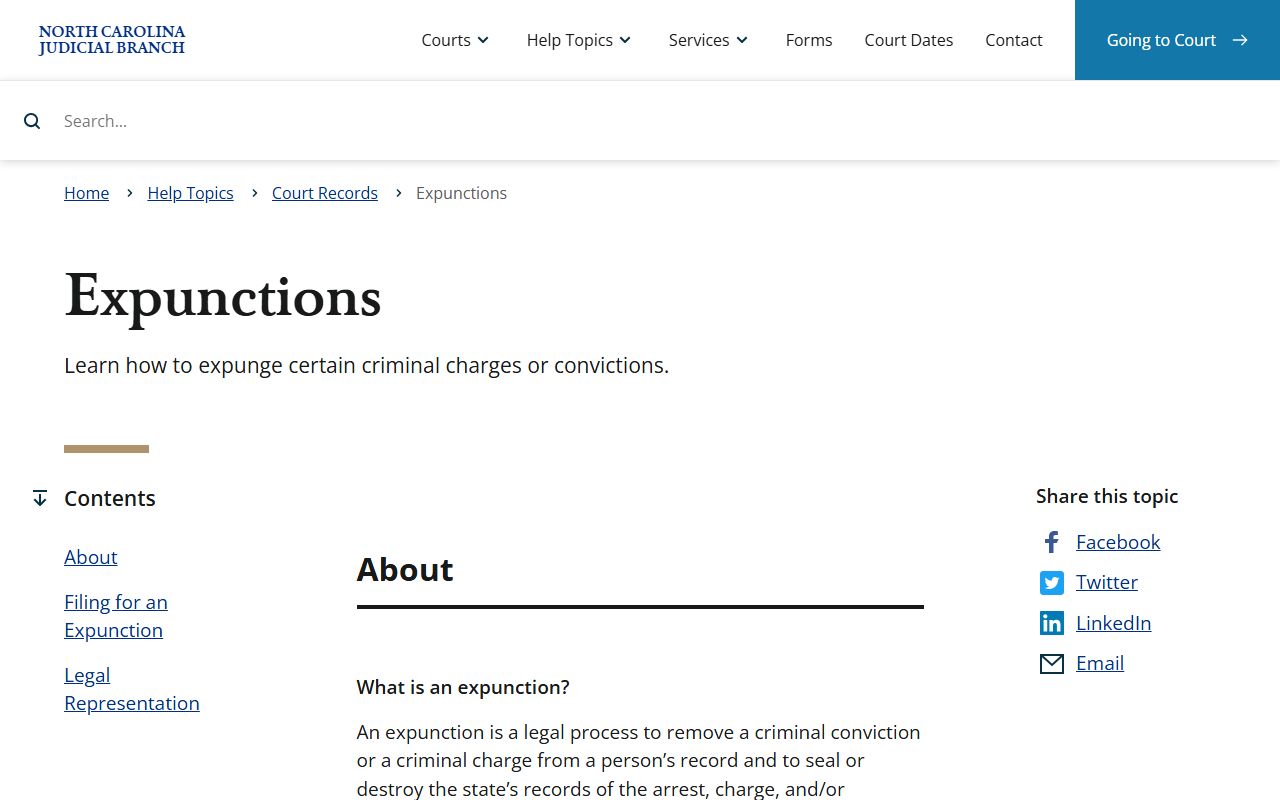
That state help topic is useful because eligibility depends on the result, offense type, age, prior record, waiting period, and petition form.
Public Access to Criminal Records
Many Edgecombe County criminal court records are public, but public access is not unlimited. G.S. 132-1 defines public records broadly, while G.S. 132-6 provides for inspection unless an exception applies. Clerk records are also tied to G.S. 7A-109. Criminal expunctions are handled under Chapter 15A, and juvenile restrictions come from Chapter 7B.
Access channels depend on the need. Portal search can locate criminal case information. Public terminals can help with criminal records in a clerk's office. Paper files and certified copies go through the Edgecombe Clerk. The NCAOC public records form is not the custodian route for county court documents or case information. For jail custody, use sheriff and detention channels. For state prison, probation, or parole, use NCDAC offender search, which is separate from county court files.
Important: Edgecombe criminal record checks from the clerk are name-based and county-limited, not fingerprint background checks.
The source image for conviction expunction law is G.S. 15A-145.5, which addresses certain nonviolent misdemeanor and felony convictions.
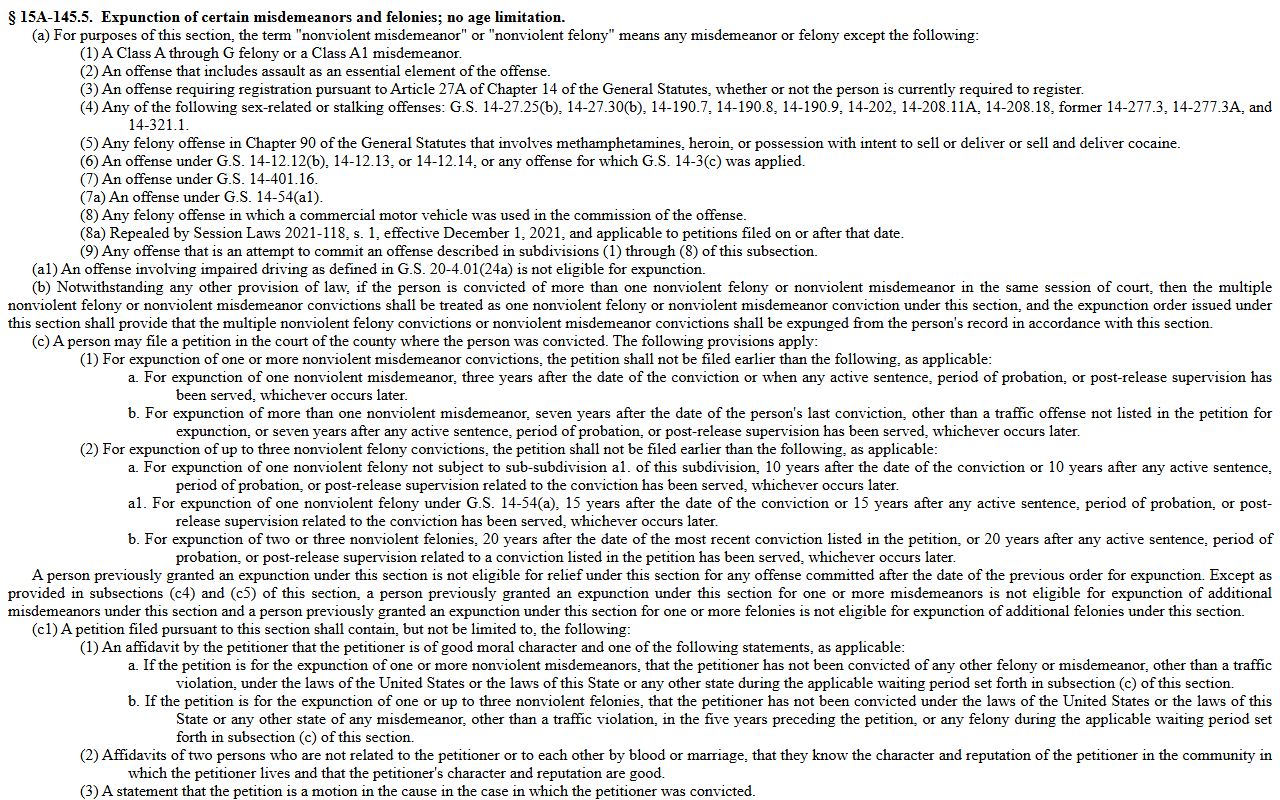
That statute is only one part of the expunction framework, so eligibility should be checked through the correct AOC form and the clerk.
Restricted Edgecombe Criminal Records
Restricted criminal records include juvenile delinquency files, sealed matters, expunged cases, victim information, protected personal identifiers, and court records that contain sensitive details. Edgecombe's Juvenile Division handles DSS abuse, neglect, dependency, adjudication, disposition, termination of parental rights, and emancipation matters. Those records are not ordinary public criminal case files.
Expunction may apply after dismissed charges, not-guilty outcomes, certain juvenile matters, and some nonviolent convictions if statutory requirements are met. A person files the correct AOC petition in the county where the case was handled, pays any required fee unless waived, serves required agencies when the form requires it, and waits for clerk or judge review. If granted, the public-facing criminal record changes only after the order is processed.
The source image for dismissal and not-guilty expunction law is G.S. 15A-146.
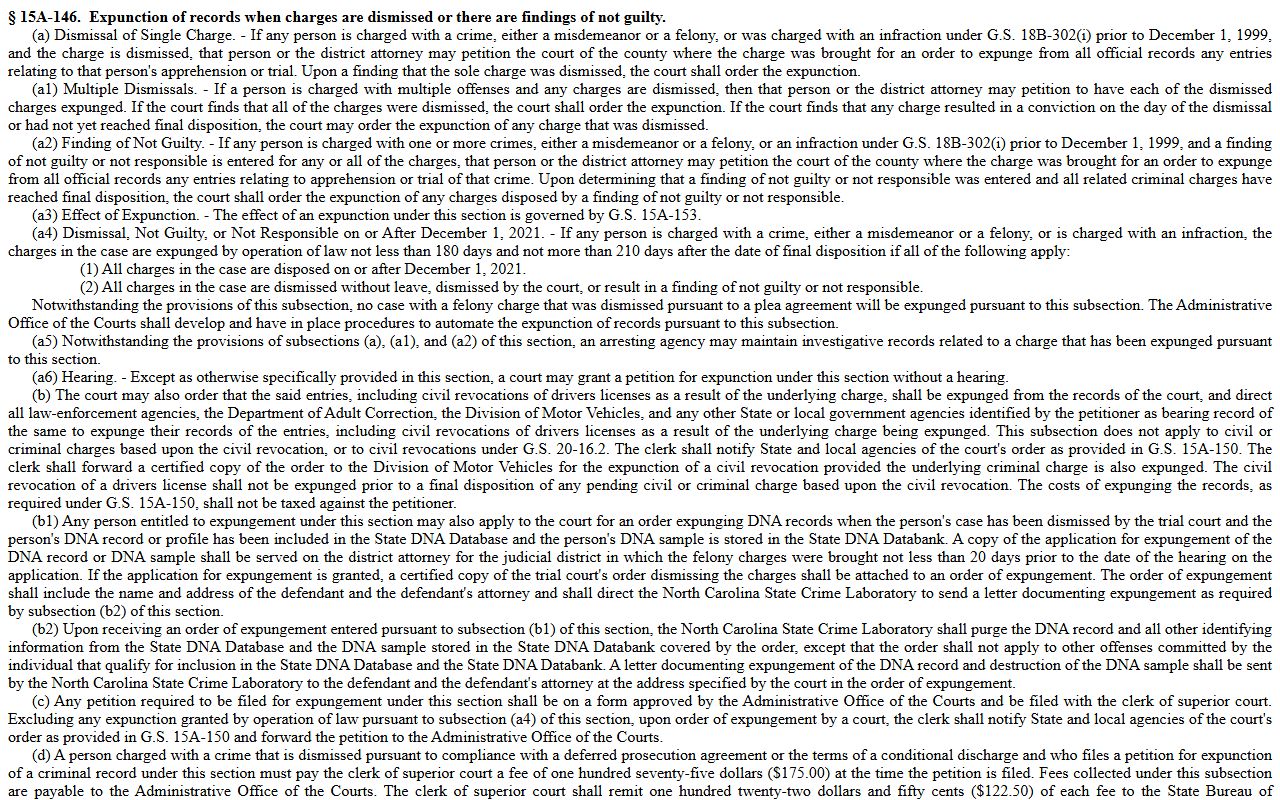
That provision supports why dismissed charges or not-guilty outcomes may appear differently after an expunction order has been granted and processed.